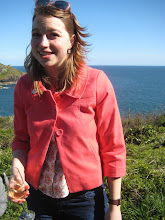
Part of a work-in-progress:
Standing on her cliff,
she watches the sea.
Like heatwaves
rising from the pavement.
Monday, May 11, 2009

Sunday, May 10, 2009
A Note on Squirrels
I am making a purple stuffed squirrel and I want to name her 'Tulip.' She is going to be constructed with purple flowery Liberty of London fabrics, stuffed with purple verigated yarn from the charity shop around the corner and deep purple embroidery thread. I think I want to name her Tulip because the skunk in Bambi is called 'Flower' and 'Flower' makes me happy inside. 'Tulip' is going to be a present for someone who is far, far away from they live, and even though I'm not sure squirrels even exist in her home country (they might only be here), I still think 'Tulip' will bring her happiness too.
Friday, May 8, 2009
May 7 & May 8
It is time to start a new. Life shock. Life shock. I want to pursue something true. I want my talents to be utilized, appreciated. Life shock. I want to love what I do. I won't love it all the time, but when I absolutely loath whatever it is I'm doing, I want there to be some part of why I'm sticking around. Cause I know that when I really want something, I will stay. I will make it through that day, conversation, interaction. Life shock. I will get there. Where? Here. In me. Life shock. Breathe. There is time. There is no rush. Breathe. Today. Right now. Here. In love.
Wednesday, May 6, 2009
Red & White
Red & white patterned cotton fabric makes me beyond happy to see, let alone touch. My fingertips want to automatically traces the pattern, as if it were raised or a different texture. Looking at my almost-finished, very first quilt, I could sew with red thread--the red of Valentine bunting--over and over, a pattern, a stitch, the red, white and pink coming together.
Inspired Laundry
Yesterday, I did the laundry. Yes, it was just the laundry, but it was inspired laundry.
Four loads of whites, lights, towels and darks shoved into my little Indesit washing machine, Ecover powder tablets and softener, and no dryer. Just the radiator racks, the laundry horse, the sock holder, multiple hangers, and the clothesline.
With the wind and the sun and inspiration. Even in the middle of London, me and nature can help each other out.
Four loads of whites, lights, towels and darks shoved into my little Indesit washing machine, Ecover powder tablets and softener, and no dryer. Just the radiator racks, the laundry horse, the sock holder, multiple hangers, and the clothesline.
With the wind and the sun and inspiration. Even in the middle of London, me and nature can help each other out.
Thursday, September 4, 2008
Why Children's Literature is Important
In the second year of my undergraduate studies at UC Santa Cruz in Literature and Feminist Studies, I took introductory theory courses for both of my majors. Literature Theory focused on the role of the author in 20th Century literature while Feminist Theories explored the construction of narratives—narratives of identities, historical and cultural constructions, the way we come to understand truth—in academic theory, in social and moral understandings, in our classroom.
From those courses I came away with two concepts: “What is the role of the author?” and “Don’t get sucked into the anecdote.” As a student of literature and an author of my own work in narrative poetry and creative non-fiction, I approach the first question from two angles. When reading and investigating a piece of literature, I take into consideration the historical and geo-political context as well as the intentions of the author and what they mean or do not mean to the work. When working on a piece of my own writing, I am often asking how my identity and intentions shape the context of my work. Thus, whether it is my own work or a piece of literature, it is how a narrative takes form—and why—that intrigues me most.
My interest in narrative construction lies not just in the story arc, but in the political and cultural ramifications of that narrative’s construction through its ability to entertain. As my feminist professor stood in front of the lecture hall, she entertained us—with stories of the author’s life or her own, of current events, or popular culture. However, as soon as we had relaxed, we were reminded not to become too enamored with the proverbial “anecdote.” “What is important about how I am telling this story?” she would ask. We were not allowed to ignore or forget that a narrative is actively constructed, shaped by context, author and reader, storyteller and listener.
While stories have intrinsic entertainment value, the way an author or story-teller constructs their narrative can be just as telling. As a student of poetry, I focused early on the importance of form. Titled “In the Telling of a Love Story” my senior thesis in Poetry was founded on the idea that form can be as subversive as content. Through that work, I tried to show how the form of a narrative about two women in love can be just as politically or radically significant as the content of the story itself.
In a similar vein, I feel the authors of children’s literature are combining form and narrative to achieve an agenda for a target audience. Children’s literature does not just entertain through this pairing, it aims to instruct as well. These stories hold their audience’s attention while also serving as tools of indoctrination, shaping the way a child sees, interacts and understands the world around them. Authors are thus actively informing the next generation’s ideas of family structures, aspects of identity, cultural customs, social interactions and an understanding of truth.
As an area of study then, I feel it is important to highlight what is currently being reflected in children’s literature about our present culture and society. What does it mean for the child to understand that not every house-hold has a set of heterosexual, biological parents at its helm? How do children form their personal identity through a bombardment of gender roles in their bedtime stories? How does an author explain the concept of sharing in a way that will prepare children for our technological, multicultural, and international society?
I hope to explore the impact of form and narrative through the Masters in Children’s Literature programme at
Subscribe to:
Posts (Atom)